Black Sea Fleet
The Black Sea Fleet is a naval fleet operating in the Black Sea. The birth of the fleet in the late 18th century is closely linked to the city of Kherson, while during the Ukrainian Revolution (1917–1918), the fleet became the arena of a sharp struggle for Ukrainization led by the Sevastopol Ukrainian Council and Bolshevik-driven anarchization.
Overview
The city of Kherson, founded on June 18, 1778, is rightfully called the cradle of the Black Sea Fleet. The mighty ramparts of the Kherson Fortress, reinforced by bastions, ravelins, and artillery of 220 cannons, reached the very bank of the Dnieper River and reliably protected the citadel — the Kherson Admiralty.
In 1917, against the backdrop of revolutionary events, a powerful Ukrainian national movement flared up among ship crews. The Sevastopol Ukrainian Council and the Black Sea Ukrainian Military Committee demanded the Ukrainization of the Black Sea Fleet and its subordination to the Ukrainian Central Rada. Despite this, far-left elements and "Centroflot" seized control of a portion of the crews, launching the suppression of Ukrainian institutions and the Red Terror in Sevastopol. In late April 1918, following the entry of Ukrainian and German troops, Ukrainian flags were raised over the vessels of the Black Sea Fleet.
Key Details / Subtopics
- Firstborn of the Fleet Slava Yekateriny: On September 16, 1783, a 66-gun battleship was launched — the first vessel of the Black Sea Fleet built in Kherson.
- The Ship Svyatoy Pavel: On October 12, 1784, a 66-gun rank vessel was launched, commanded by Captain 1st Rank Fyodor Ushakov.
- Campaign to Sevastopol: after being fully fitted out, both ships set course for the new Black Sea harbor — Sevastopol. The 50-gun frigates Kherson, Krym, Khorobryi, and others joined the fleet one after another.
- Ukrainization and the Destroyer Zavidny (1917): Ukrainian councils were established on naval vessels (notably an influential cell on the destroyer Zavidny), demanding subordination to the Central Rada.
- Black Sea Electoral District (1917–1918): To conduct elections for the Constituent Assembly of the UNR within the navy, a Black Sea District was created (comprising shipborne and shore-based crews).
- Bolshevik Anarchization and Disbanding: In January–February 1918, "Centroflot" opposed the Central Rada, while Bolshevized sailors carried out a wave of bloody terror in the city. In late April 1918, the fleet raised Ukrainian flags.
- Naval Testing Grounds and Residual Mine Danger: The USSR Black Sea Fleet long used the Black Sea waters (particularly near Cape Lukull) as naval testing grounds. Thoughtless lifting of restrictions in the 1990s led to depth charge explosions and loss of civilian vessels, including the fishing seiner Shkval in 1998.
- Sinking of the Battleship Novorossiysk (1955): On October 29, 1955, as a result of a sabotage operation by Italian frogmen of the 10th Flotilla MAS, the flagship of the USSR Black Sea Fleet Novorossiysk (former Giulio Cesare) exploded and sank in Sevastopol Bay, killing 829 people.
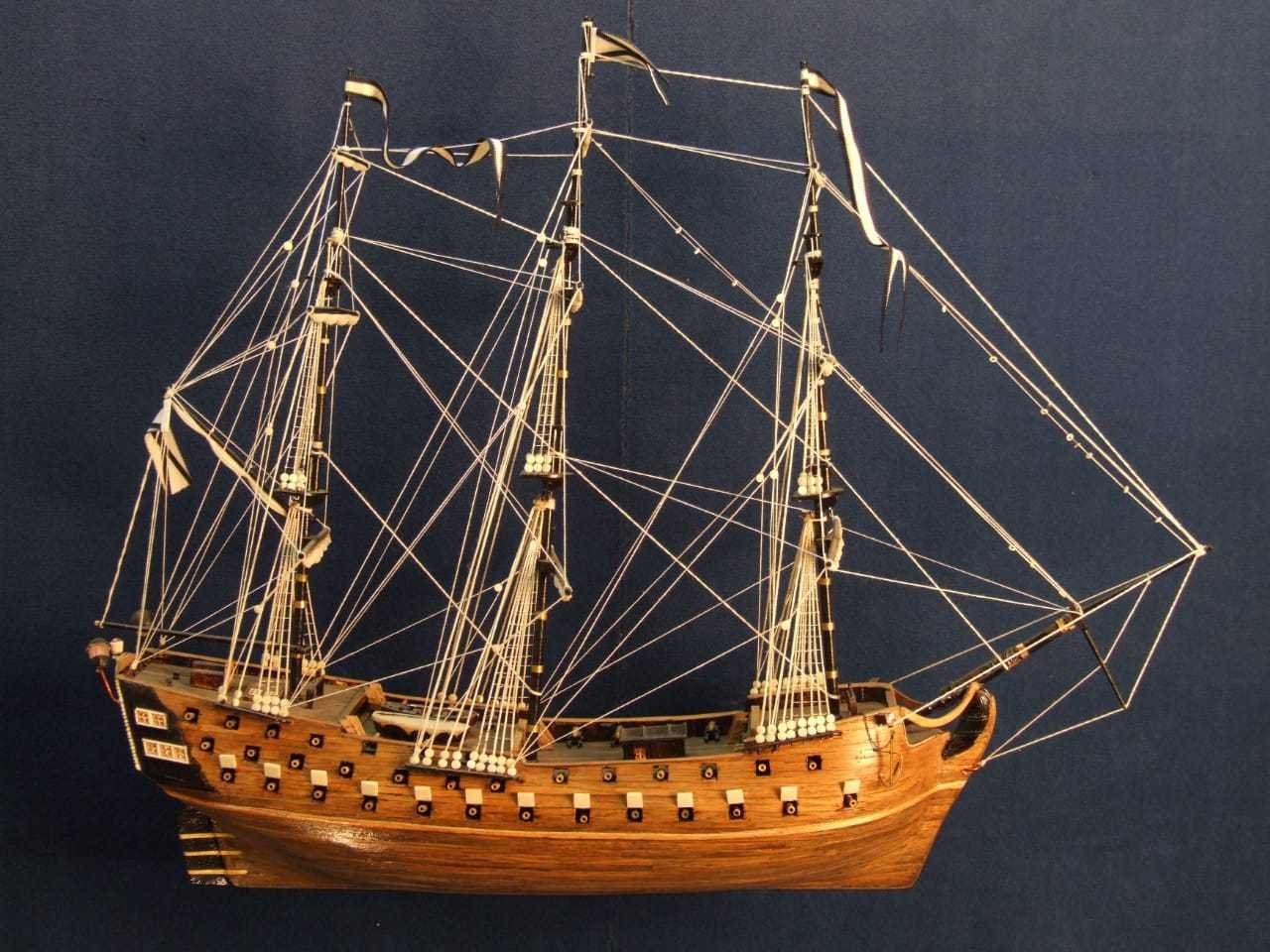 Model of the ship "Slava Yekateriny". Authors Yu. Smirnov, M. Lomakin. Scale 1:100. Length – 50 cm.
Contradictions and Open Questions
Section empty — no contradictory information in available sources.
Sources and Links
- Kherson – Cradle of the Black Sea Fleet — main source on the founding of the fleet in Kherson.
- "What the Revolution Gave Us": Attempts at Unifying Sevastopol with Ukraine in 1917–1918 — source on the Ukrainization of the Black Sea Fleet in 1917–1918 and the Bolshevik terror.
- Sevastopol Ukrainian Council (1917–1918) — body that headed the Ukrainization of the fleet in 1917–1918.
- Red Terror in Sevastopol (Winter 1918) — mass executions carried out by Bolshevized sailors of the Black Sea Fleet.
- Kherson Admiralty — shipyard where fleet ships were built.
- Fyodor Ushakov — commander of the ship Svyatoy Pavel.
- Mystery of "Admiral Nakhimov" (Nuclear Testing Off Crimea?) — Black Sea Fleet, during whose exercises an alleged underwater nuclear test occurred near the cruiser.
- Kherson — Center of Maritime Education in Southern Ukraine — Kherson's maritime education trained personnel for the commercial fleet — a component of the Black Sea Fleet's nautical tradition.
- Crimean Lighthouses — Lighthouses ensured navigational safety for the Black Sea Fleet and merchant vessels; following the 2014 annexation of Crimea, the rf Black Sea Fleet illegally seized Crimean lighthouses.
- Crimean Impassable Roads — supplying the fleet during the Crimean War relied on overland routes and horse-drawn transport due to port blockades.
- Black Sea Fleet Aviation — History of shipborne and hydro-aviation of the fleet at its inception (WWI, Zonguldak raid).
- Frigate Sahin Giray — frigate of the same name that became a russian war prize in the 1811 russo-Turkish War and served in the Black Sea Fleet under the same name.
- Black Sea Dolphins — in 1965, a military dolphin base was established in Sevastopol; Navy vessel Delfin (1926) hunted a whale in the Black Sea.
- Airship V-12 "Pobeda" Over the Black Sea — in 1916 in Sevastopol, the Black Sea Fleet formed an aeronautical (airship) detachment; in 1945, V-12 reconnoitered mines over the sea.
- Crimean Energy Sector — Black Sea Fleet infrastructure required the electrification of Sevastopol (first power station 1897–1899).
- Deadly Gift of the Sea — article on the Soviet depth charge explosion on the fishing seiner Shkval in 1998.
- Sinking of the Flagship — article by Valeriy Verkhovskyy on the sabotage against the battleship Novorossiysk in Sevastopol.
- Mine Hazard and Unexploded Ordnance in the Black Sea — residual explosive hazard from Soviet Black Sea Fleet naval ranges.
- Sinking of the Battleship Novorossiysk — detailed account of the 1955 Sevastopol Bay tragedy.
- Valerio Borghese — commander of the 10th Flotilla MAS, organizer of the sabotage explosion of the battleship Novorossiysk.
- Marine Fishing and Fish Industry of Crimea — civilian fishing in the Black Sea imperiled by ammunition and Black Sea Fleet ranges.
- Seiner Shkval — vessel sunk due to the detonation of ordnance from a USSR Black Sea Fleet range.
- Battleship Novorossiysk — flagship vessel of the USSR Black Sea Fleet (former Giulio Cesare).